

~This interlude is a short break from the memoir; although not directly Henry-related, it’s nonetheless a formative story that shaped my expectations for men. We’ll be back to our regularly scheduled programming with Chapter 11 on November 11th.~ xx -Rach
Just a few short weeks ago, the internet was awash with calls to action, particularly for men, in the glaring floodlight of the Cornell (5)7 case. It felt like the loudest the internet has been about sexual assault since Brock Turner. Although the chatter has already quieted some, it’s stayed with me. For days, it was all I could think about. Like so many, I felt pushed into a state of remembering, into a fresh, piping hot wave of rage. Interactions that might have felt dismissible a week before suddenly felt triggering, a la Shane Gillis’ ill-timed and total bomb on SNL.
Overall, women and survivors seemed pleased to see men speaking out about this case, while also being critical of the men posting about it. I felt the same way. Posting about the Cornell 7 without actually taking action or accountability or changing anything about their lives felt the equivalent of posting a black square in 2020 without doing the decolonizing, racial justice work.
I watched one guy reflect on some sus behavior he witnessed in his frat a decade ago. While seeming vulnerable as he told young collegiate men to speak up where he hadn’t, I didn’t feel like he’d gone deep enough. I didn’t feel like he'd actually asked himself what he could be doing right now. It felt like a move in the right direction, but hardly warranted applause. I feel like we are all desperately waiting for men to wake up.
What became abundantly clear in the discourse was that people are differentiating between good men and predators differently. Men who think of themselves as the good guys are not doing nearly enough; in fact, many of them are actively causing harm and perpetuating the rape culture they claim to abstain from.
This sentiment bred the widespread use of this infographic:
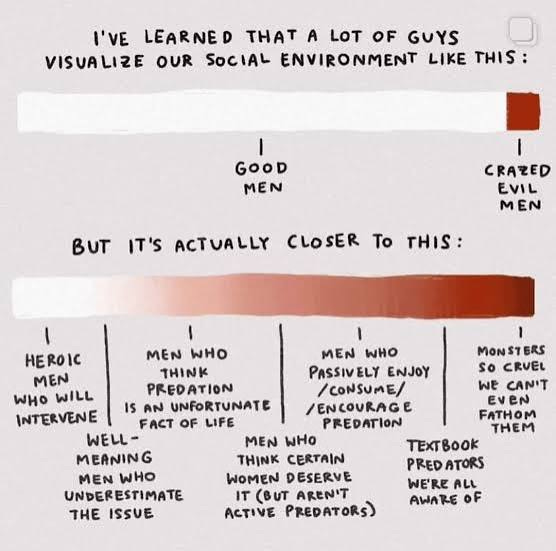
Not all of the men in my life fall neatly on the left side of this graph. Perhaps most don’t. This is the cultural shift that I think we could see in my lifetime. It feels possible, if men are part of the dialogue and start speaking up for women when we’re not in the room, to see our culture shift toward the white side of the chart.
In this vein, Shannon recorded herself talking about what she wanted straight men to start talking about: she wanted to hear the stories of the men who undertook personal risk to support women and survivors of SA. Who lost a job for reporting a boss to HR? Who turned down the scholarship because the program had accepted a rapist? Who lost the football career, the spot on the team, the friendship, the seat at the table? People like Henry are sitting amongst us. How are we creating and changing the norms so that their behavior is unacceptable and followed by cultural shame?
How do we make it so no one wants to be friends with a rapist?
So that no one laughs at the rape joke?
So that guys think it’s worse to be called a rapist than it is to be called gay?
Which prompted me to tell you the story of my friend. My first (and possibly only) male ally. We'll call him Prabir. Prabir is the only man I’ve ever known to make a real personal sacrifice in order to condemn intolerable rapist male behavior.
Here’s the story.
It was winter break 2016; Donald Trump had just been elected for his first term, I’d been broken up with Henry for some time, I was halfway through my junior year of college, and I was back in Arizona for the holidays.
Many of my friends from high school attended Arizona State University, a college known for its merits but also its parties and record-breaking underage drinking arrests during Welcome Week. I was getting ready and going out with two of my girlfriends to meet up with our old high school friend group on their new stomping grounds — the bars of Mill Avenue. In our truly wholesome plan, my mom was dropping us off at ASU in the Toyota Sienna I learned to drive on, and we’d Uber back to my house at the end of the night to sleep off the alcohol.
I’d been drinking at college mostly with my Mock Trial team, which was a relatively closed group. Like many college students, we drank heavily with the goal of getting drunk. Sometimes people would brown or black out, or throw up. But we were a close group of thirty nerds, we were usually drinking at someone’s house, and we walked each other home as much as possible. This, I thought, made our binge drinking ‘safe.’ Or at least, safer.
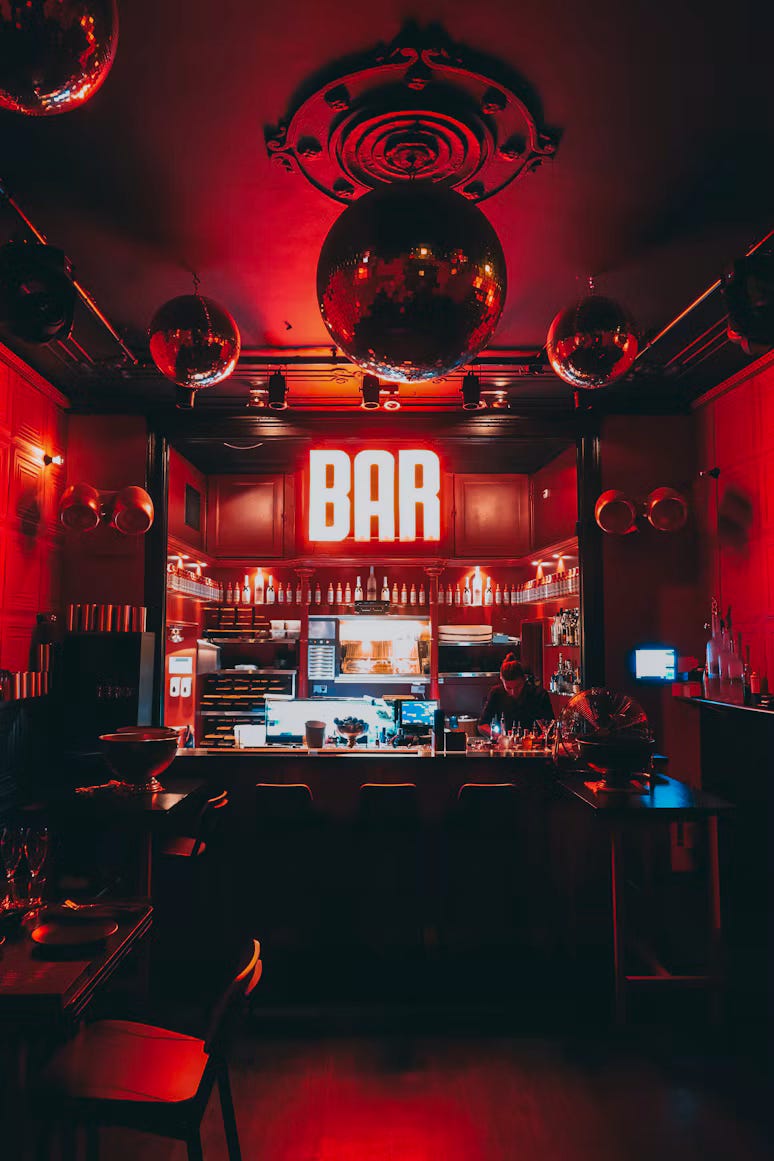
Partying in Arizona with my high school friends, out at the bars, was a totally new ballgame. I had only just turned 21 that month, and I’d never had a fake. We ended up at a bar on Mill Ave called Whiskey Row. I had a little more to drink than I planned — that, or the drinks are poured heavier out west.
Either way, I start to feel the buzz pretty heavily — I’m not a mess, not blacking out at all, but I’m certainly drunk. The problems begin.
I kiss a guy from high school, who I don’t know very well, in the dimly lit bar. It’s out of character for me, which snaps me out of it. I decide pretty quickly that I want this to stop. I tell him this, we stop, I walk away, and I start avoiding him at the bar.
He follows me everywhere. He pops up at every corner, looking for me. No matter how many times I tell him I don’t want to make out anymore, he keeps showing up, cutting in front of me, appearing behind me in line at the bar, waiting outside the bathroom for me to come out. He tries to initiate kissing again.
At the same time, a different guy friend from high school has seen us kiss, and he’s not pleased. This guy and I were much closer back in the day — I thought of him as a true friend, someone who I talked to and went for bike rides with, whose dad I had met and whose house I’d been to — and we’d always had a little chemistry, a little tension. I remember us dancing the first time I ever drank at a party, realizing far too late how much my short dress had hiked up. We didn’t do anything more than dance, but I felt so embarrassed and guilty about it.
Right before I went away to college, I was at a different high school party. My girlfriend — the same one I’m out with at Whiskey Row — had put me to bed in her sister’s room after she found me nodding off in the bathroom. This guy let himself into the room I was sleeping in later that night. He laid in bed, fully clothed, and I was confused as to why he was there. I remember trying to kick him out — possibly half-heartedly — and I remember him fully picking me up in his arms and out of the bed. My girlfriend kept trying to get him out of the room and away from me, but he fought back. Again, nothing happened, but it wasn’t quite right.
This all comes back to me as I watch the anger flash across his inebriated face now that he’s seen me kissing his friend, a guy I hardly knew or talked to in high school. Now this guy I thought of as a ‘good friend’ also starts cornering me in the bar, trying to have ‘talks’ with me. He’s much larger than I am. He puts his entire arm around my neck, in what felt like a chokehold, where I could not escape or squeeze away. Other people had to tell him to let go of me, to leave me alone. He pulled me off to the side to sternly talk with me about what we once had at least twice. In short: he’s jealous, and now he’s mad.
My girlfriends dutifully tried to pull me away from both men, dragging me out onto the dance floor and into the light. A few times, I had to literally run through the bar to keep them away from me. Finally, we were simply no longer having fun. I couldn’t go anywhere without one of the guys showing up, and they started feeling like sharks circling the water. My two girlfriends and I decided we had to leave.
We snuck out of the bar and called our Uber, but we had to fully cross the street and hide behind another building to not be seen by the two guys who both exited the bar looking for me, and who were both blowing up my phone. The guy I kissed didn’t even have my number, so he called me from Facebook Messenger over and over. Finally, we three girls slid into the Uber, safe at last.
* * *
The next day, the three of us wake up in my still-purple childhood bedroom and start dissecting the night and how fucked up it was. I unfriend the first guy on Facebook. We never really knew each other, I think he’s creepy, and I want and need nothing to do with him. I want to erase his call record and forget about him. It doesn’t even hurt to cut the tie. In fact, I find it sucks in a predictable way, in a men-proving-me-right way. I was surprised by his behavior — I mostly knew him from advanced calculus class where he got great grades and didn’t talk too much. But now that I know that this is who he is with a little freedom and alcohol, I have zero interest in him whatsoever. Blocked. Good-bye.
Thinking about my other friend hurts a lot more. We were close, or so I thought. I really cared about him; we kept up with each other sometimes despite being at different colleges. He was someone I looked forward to seeing when I was home.
Immediately, armed with my knowledge from women’s studies classes and newfound liberal beliefs, I confronted him. I figured he hadn’t meant to be so obnoxious and threatening. I gave him the benefit of the doubt and assumed it was an overstep and an accident. I also assumed that I could educate him, that it was my duty to speak up so he would be better to other women. He agreed to talk, and that day, we had a long phone call where I told him what happened (because he blamed his behavior on the alcohol and acted like he didn’t remember it quite the same way) and he apologized profusely.
In theory, I forgave him. Out loud, I forgave him.
But I never quite got a good feeling about him after that phone call. He took the punishment like a bad dog who knew he was being bad, got caught, and would totally take the sandwich off the table again next time no one is looking. To this day, I don’t think he wanted to hurt me. But I do think he would have happily left that bar with me, no matter how drunk we were. I did feel like his mission that night. I did feel scared when his arm was around me. I was uncomfortable by the neck-grabbing, the whisper-scolding so close to my face, the chasing out of the bar, the phone calls into the night…
He and I haven’t been close since, though a few times over the years, I’ve attempted half-heartedly to resurrect our friendship or inquire as to his well-being. But every time he’s answered, I’ve felt disinterested and let the conversation dry up. I don’t really know why I’ve even tried. I miss his friendship, I guess. He was funny, and witty. His name still comes up in my circles sometimes. I don’t bring this night up very often or tell new people about it. Deep down, I still wish the best for him. I don’t know if that makes me an idiot. Someone with a lot more expertise than me will hopefully invent the restorative justice paradigms we need to turn these incidents into teaching moments that allow everyone to stay safely in community with each other, with accountability and healing.
Instead, I reached out, I tried to explain the harm that had been caused, I still didn’t feel any better, and I couldn’t trust him anymore, so our friendship shriveled.
He and one of the girlfriends that accompanied me that night attended the Women’s March together in Phoenix the following month during Trump’s inauguration.
This could just be another story of women doing what women have always done: protecting each other. Without my girlfriends’ help, I might be recounting a very different version of events. I could have been talked into another drink, ‘helped’ home by one of these men, and found myself the next morning in the wrong bed with the wrong kind of hangover.
But after the incident, which at the time I didn’t think of as an ‘incident’ but rather a disappointing demonstration of two boys’ true character, I told one other person about it: my friend Prabir. He’s what makes this story stand out.
When Prabir and I met up for coffee, I told him about our two mutual friends at the bar: the kissing, the chasing, the discomfort, the running away. I spoke to Prabir, a straight man, like he was one of the girls because he made me feel safe, was actively listening and engaged, and quite evidently, believed me. Encouraged, I shared the whole story, withholding nothing. I didn’t try to make a strong case against them or even tell him that I hated those guys; I just shared the story honestly, as it happened. Can you believe?!
And then Prabir did something bonkers. That week, he ended his friendship with both of them, immediately, going off of only my word. My word.
He didn’t bother me with the burden of proof. He didn’t ask to see my phone log (which did show how many times my ‘friends’ called me at two in the morning). He didn’t ask me how many drinks I’d had or why I didn’t have a bigger dinner if I knew I was going out. He didn’t tell me I shouldn’t have made out with the first guy in the first place or that I was leading him on. He didn’t call my girlfriends to hear another point of view or corroborate my statements.
He actually understood consent and rape culture. He understood on a basic level that they were treating me more like a piece of ass to score than a human being and lifelong friend. They didn’t even technically assault me, and he… he was actually mad at them.
Prabir publicly, in the all-guys group chat, announced that he wasn’t cool with the way those guys were acting and said he didn’t want to be in the group chat anymore. He exited. He fully ended the friendships; I guess he’d heard that the guy I’d kissed hadn’t been treating women so well at his school out of state, either. I didn’t see the texts or screenshots, so I don’t know how much he elaborated, but he basically hasn’t been friends with either of those guys since. It’s been a decade.
Prabir had been friends with both guys for a long time, although he was truly a childhood friend of the guy that I kissed. My hometown had an Intel campus that attracted a relatively large number of Asian families. In some of my classes, a third of the students were first- or second-generation South Asian Americans and a third were East Asian Americans. Most of the remaining students were white. The South Asian students were a tight-knit group, and they often referred to themselves as “Brown Town.” The Bengali community in Chandler, Arizona wasn’t exactly enormous — these guys had grown up attending the same holiday events, weddings, and funerals their whole lives. They were family friends. Prabir exiting the group was no small thing.
Though Brown Town was a big group, there was no doubt that they still experienced bullying, racism, and the liminality of being raised by two cultures. It couldn’t have been easy to be young South Asian boys in an American high school. After I read this piece, “Oriental Jane Doe,” (read it when you finish this!) about Winston Lee of the Cornell 7, it was clear that there is nuance to race and power in the United States when it comes to sexual assault that I am not the expert voice on. It is frustrating that men can gain privilege amongst other men (especially more powerful/elite men) by picking the low-hanging fruit that is putting down women.
Maybe the men who followed me around the bar that night struggled with feeling emasculated and racially profiled; maybe on their journey to seeking other men’s approval, joining college fraternities and getting p*ssy however and whenever they could was the fastest track toward acceptance. There can be layers to oppression.
But Prabir was still willing to condemn his friend’s inappropriate behavior and hold his inner, closest circle to a higher standard.
My feeling, when Prabir told me he was going to stop talking to both guys and removed himself from the chats, was actually one of horror. He doesn’t need to do that for me! I was just telling him what happened. I myself was still toying with the idea of forgiving at least my friend who’d gotten on the phone with me and heard my side of the story. It was bad, but it wasn’t, like, that bad. Once again, I found myself downplaying the danger and objectification I’d been subjected to. My internalized misogyny told me that I was overreacting, that I might have interpreted their actions incorrectly, that nothing really would have happened.
Then I remembered the feeling of seeing them both outside of the bar, phones out, scanning the street for me. Then I remembered getting in the Uber in hiding. Then I remembered my girlfriends looking out for me and helping me escape, and I remember the other instances when I was drinking and my ‘good’ friend snuck into my bed without permission.
I recounted the words I’d told Prabir. I had been honest. I had been upset. I just hadn’t expected him to do anything about it. Just telling him what had happened had been cathartic enough, I thought. I really hadn’t expected him to stop being their friend over it; in fact, that thought just flat-out never occurred to me.
It sounds silly now, but I genuinely didn’t know that taking action like that was possible; I’d certainly never seen it executed in real life. The idea of ending my friendship with the guy who’d been so jealous felt ludicrous, like coloring outside of the lines. These were just the things that men did that women forgave or laughed off. If it wasn’t a little funny, then it was super depressing. I realized the role that I constantly had in normalizing men’s behavior so that I could try to survive it with my sanity.
Prabir taking me so seriously gave me the permission that I didn’t know I needed to take myself seriously. To quit downplaying what had happened and accept that these guys… these guys were never my friends at all. Perhaps that was the most painful realization of all.
* * *
In 2016, some of Prabir’s friends told him that he was overreacting when he ‘canceled’ those guys and left the group chat. Some of the same people who told him he was overreacting just posted about the Cornell 7 last month.
I wonder if any of them would actually leave the group chat this time.
Food for thought.
xx
P.S. “Prabir,” if you’re reading this, I love you. You make me better. Thank you.