

On Tuesday, March 18th, the morning after my eighteenth birthday, I stood in line at my gate at the airport, trying very hard to summon the confidence of someone who flew alone all the time.
It was ungodly early, five a.m. or close to it, but I was wide awake anyway. Practically vibrating. I had never flown without my parents. I had never left the country. And the country I was headed to was the one I’d been obsessed with my entire life.
For months I had been crossing off the days to this trip in my school planner. First, I’d spend a few nights in Miami with my aunt, uncle, and cousin Nico. Then all of us would fly to Panama together and stay at my cousin Camila’s house. The trip would last two weeks, starting a week before my school’s spring break, so I could get the most out of it without missing too much school.
Panama had always been a special interest of mine because my mom is half-Panamanian, and for as long as I can remember she’s tried to hold on to that heritage. I grew up with her always reminding my sisters and me “we are Hispanic,” urging us to learn Spanish, and feeding us Panamanian foods. As a quarter-Latina in small-town Wisconsin, I had become aware of how easily that piece of my identity could slip away if I didn’t nurture it. So I took all the Spanish classes I could, and did school project after school project on Panama. I remember being in sixth grade, presenting on Panama for the first time, smiling and twirling in an authentic pollera I borrowed from my abuela.
But still, I was a white girl. The world saw me and treated me as white, and I was Irish and German too. I used to joke that I didn’t inherit the Panamanian traits I wanted from my mom—her caramel skin and petite frame—and instead got her dark eyes and thick body hair. In middle school a classmate told a group of friends, “Shannon never shaves her armpits,” when in reality I shaved them every morning before school; the hair was just dark beneath the surface, and I couldn’t hide it like my Midwestern peers. For the most part I felt white, but still there would be little blips like this, the occasional small tear in the fabric.
At baggage claim, I saw my uncle, Tío Manuel, scanning the crowd for me. When our eyes met, he smiled wide.
Tío Manuel was a Cuban immigrant married to my abuela’s younger sister, Paulina, who was a Panamanian immigrant like my abuela. Because of the age gap between my abuela and her sister, the actual family tree never quite matched how things felt. They were close enough in age to my parents that they were an aunt and uncle to me, not grandparents. And their sons, Nico and Gabriel, were my cousins. That was kind of the way of Latin culture. If we were related in even the slightest way then that meant we were primos, cousins.
Tío Manuel took my suitcase before I could argue, leading me to the car, talking the whole way in heavily accented English. At their house I was greeted by my aunt, Tía Paulina, holding her small dog in her arms, Teddy.
“Holaa Shanno! Ay, mami, it’s been so long, no?” Tía Paulina spoke with an accent almost as thick as Tío Manuel’s.
I was thrilled to see her but still I cringed a little when I heard her say my name. I hated how my name sounded in Spanish, how a lot of Spanish speakers dropped the final -n, pronouncing it like “shawn-oh”. I was always annoyed that my parents had to give me not only an Irish name, but one that sounded so ugly in Spanish. Tía Paulina tended to call me “mami” because it rolled off the tongue a little easier, and I welcomed how warm and endearing it felt coming from her.
My abuela had a nearly identical small dog to Tía Paulina whom she loved just as dearly and, funnily enough, was also named Teddy. But beyond that, Tía Paulina couldn’t have been more different than my abuela. My abuela lived a quiet life in rural Wisconsin with my grandfather, entirely in English, raising chickens or goats or rabbits and going to Catholic mass every Sunday. Meanwhile, the only reason Tía Paulina was speaking English at all was because I was there. And even then she still mixed in some Spanish. I loved when she did—I tried to mix in some Spanish too where I could. She was a talkative woman who went to the salon every week to get her hair done, had tattooed eyeliner and eyebrows, and never shied away from a party.
This trip was going to be fun.
After settling into my room in their house, I waited for their son, my cousin Nico, to get off work. Around 8 p.m. I heard the front door, then his voice in the hallway, miraculously still full of energy after a twelve hour shift as an ER nurse.
“Get dressed, prima. We’re going out. We’re meeting up with my friends.” I looked at Nico, still in his scrubs, surprised that we apparently had evening plans.
“On a Tuesday?” I asked, looking now at my own clothes, leggings and a T-shirt from traveling.
“Yeah, this is Miami. We’ll have some cafecito before we go.”
Espresso at night. Wild. I do remember hearing once that this was something Nico did. I was at my parent’s kitchen table in Wisconsin, waiting for Henry to walk through the door.
In November of 2011, Tía Paulina, Tío Manuel, and their two sons Nico and Gabriel traveled all the way from Miami to join my family for Thanksgiving. Henry and I had been together for over a year, and I couldn’t wait for him to finally meet this side of my family.
They had arrived bearing gifts like Cuban coffee and tequila, and Tía Paulina brought me homemade jewelry for my belated quinceanera, a milestone my family in the Midwest didn’t celebrate. They were brimming with energy and zest for life, my aunt and uncle throwing back tequila shots with my parents and regaling me with stories of their sons drinking cafecito at night when they went out in Miami.
Henry joined us one evening during their stay to meet them, and I was thrilled. I led him into the kitchen where everyone was gathered around the table.
“This is Henry!” I said, maybe a little too brightly.
They greeted him enthusiastically, especially Nico and Gabriel. They were older than us—Nico by six years and Gabriel by ten. They were tall and tanned, wore cologne and trendy clothes. They were personable and eager to engage with Henry after having heard so much about him from me.
But then, much to my disappointment, Henry withdrew in their presence. The atmosphere quickly grew awkward. My aunt, uncle, and cousins were a lively, talkative bunch, while Henry spoke as few words as possible. He avoided eye contact and eventually left the kitchen where we were all gathered, retreating to the living room alone.
Henry didn’t have to act like this. I’d seen him work his charm on my mother, make my sisters laugh. There was a side of Henry that could’ve had my cousins eating out of his hand in ten minutes. Instead he chose to sit on the edge of the living room with his back to the kitchen.
“He’s just shy,” I told Tía Paulina when she asked if he was okay. But that was a lie; shy people don’t look up from across the house and hold your eye just long enough to make sure you know it’s on purpose.
Given Henry’s reserved, brooding demeanor, Nico took to calling him “Edward,” a reference to Edward Cullen from Twilight. I knew immediately that Henry would be pissed about the nickname; pointed jokes were rarely received well by him. Yet in secret, I found it rather fitting. I couldn’t blame Nico for teasing him a bit, considering Henry’s reluctance to engage with my family.
Henry, as he often did, took me aside to scold me. He labeled Nico a creep, saying my failure to confront him about the nickname proved I was afraid of him. He went further, insinuating that Nico had ulterior motives, that he probably wanted to have sex with me, and warned me to stay away from him for my own safety.
Normally I didn’t push back on what Henry told me, but this was different. I reminded him that Nico was my cousin. But my hesitation to believe him made Henry double down—he began to insist that he could see Nico’s true intentions, and that my inability to see it was a testament to my naivety.
Then Henry told me that if I offered Nico a blowjob that he’d accept it—the comment so jarring it burned into my brain. I nodded once, saying nothing. But to myself I still thought, that’s insane, there’s just no way. I couldn’t bring myself to believe Henry’s accusations about Nico, but I already learned it was usually wiser to keep my thoughts and opinions to myself.
My aunt and uncle were staying in my room for their visit, so that meant I was bunking in the bonus room with Nico and Gabriel. Henry had left for the night hours ago but still bombarded me with texts—insisting I find a way to leave that room and tell my mom about Nico’s alleged perversion. Over text, I placated him, but in my mind I was resolute: Nico hadn’t done anything wrong.
When everyone else in the house had drifted off to sleep, I quietly slipped out of the bonus room and tiptoed through the darkened house to the living room couch, exactly as Henry had instructed. I dialed his number and pressed my face into the cushions as I whispered reassurances that I was away and safe. Henry emphasized that in the morning I needed to tell my mom about Nico. I promised I would.
After we hung up, I lay wide awake, my mind racing for hours. I thought about how in the morning there would be questions about why I’d slept on the couch, and how I wouldn’t know what to say. Eventually I got up and snuck back into the bonus room. I never confessed to Henry that I didn’t stay on the couch.
After my family’s visit, Henry kept pressing me to talk to my mom. I felt incredibly uneasy, because I truly had nothing to tell her. But under his persistent urging, I made it as far as approaching her in her bathroom while she got ready for the day. I awkwardly said I needed to tell her something about Nico.
“Sure, sweetie, what’s up?” My mom’s gaze was fixed on me, attentive and patient. Yet despite her readiness to listen, I froze.
“Well, he…” My voice faltered as I searched for the words. Anxiety washed over me, and I shook my head. I had nothing, and it felt wrong to make up something so serious about Nico. With a wave of my hands, I retreated from the room, stepping backward. “Never mind, it’s not important,” I mumbled.
I kept the truth from Henry: I hadn’t said a word. He was trying to make me believe Nico had done something disgusting, but I saw through it. For the first time, his tactics were lost on me.
After the holiday, Nico and his family flew back to their home in Miami, so I didn’t have to worry about keeping Nico and Henry apart. I hated the idea of cutting ties with family, but once Henry formed an opinion about someone or something, it was nearly impossible to change his mind. As far as I knew, my chance at a relationship with the Latin side of my family was lost.
Now it was 2014, and the man Henry warned me about was handing me a cup of cafecito.
“Prima. Where are your heels?” He was looking down at my strappy black sandals.
I hadn’t packed any heels. Nico looked genuinely appalled.
“We’re fixing that before Panama,” he said. The next day he marched me to the mall to buy some.
Soon enough, Nico and I were in Panama, basically attached at the hip, and nothing about it felt dangerous.
Panama was everything I wanted it to be and more. Food, drinks, dancing, sightseeing, family. So much family. I met a new relative almost every day. I met my great-uncle for the first time. Then I met his granddaughter, who was my age, and I hadn’t even known she existed. These connections were precisely what Henry tried to keep me from, and he failed so miserably that I couldn’t help but smile and soak in every moment.
On one of the last nights of the trip, our cousin David, who was a Panama resident, wanted to take Nico and me out with him and his friends to enjoy the Panama nightlife. Before going out, my cousin Camila, whose house we were staying at, offered to do my hair and makeup. She gave me a high ponytail with face-framing pieces, a bold red lip, and lent me some chunky gold earrings. I was almost giddy—she had me feeling so Latina. I excitedly put on a striped maxi dress I bought specifically for this trip to complete the look.
Later, Nico and I found ourselves at a ruin bar in Casco Viejo called Espacio that had stone walls and no ceiling. We joined David’s friends, all men, at a table. Nico and I were the only English speakers in the group, but Nico was bilingual, so naturally the night was in Spanish.
I could understand Spanish decently by this point in the trip, even if I was shy when speaking it. But still, drunken, slurred Spanish in a thick accent went right over my head. I didn’t mind too much—I entertained myself with the tropical Panamanian air, the sexy red bar lighting, and the loud Latin music, where every other song was by Pitbull or Shakira.
Nico sat to my right, and to my left sat a friend of David’s, roughly in his thirties, in a light pink shirt with a classic gold wedding band on his left hand. He inched closer, bit by bit, until his hand was on my knee, and he slowed his speech so I could understand. He called me “mami,” which struck me as odd, but of course “Shannon” isn’t the most comfortable name to say in Spanish. I didn’t know Latin culture well enough to know if it was weird that an older man who I just met was calling me this. Tía Paulina called me “mami” more often than she used my actual name, but I wasn’t sure if I’d heard a man call me that yet. And I really wasn’t sure how to take it when this guy did it.
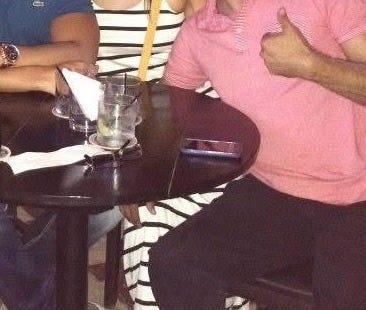
I got up to go to the bathroom, and on the way back Nico intercepted me to take a few mirror selfies before whisking me to the bar to freshen our drinks. He turned to me.
“That guy in the pink says disgusting things about you when you’re not around.”
“Like what?”
“Well… he keeps saying he wants to marry you. That he’d marry right now if he could.” He kindly didn’t elaborate further.
Nico suggested we skip the table and head down to the basement dance floor instead, and we slipped down the stairs without giving David and his friends a heads-up. It wasn’t long before they ended up there too, and the married man in pink followed me like a puppy. On the dance floor, at the bar, at a table—he was breathing over my shoulder everywhere I went. When he grabbed my hand where it rested on a table, I pulled it away.
“You don’t like?” He widened his eyes and smiled, doing everything short of licking his lips to make me feel like a prey animal.
I smiled awkwardly and shook my head.
I was disappointed in myself. I assumed I’d stand up for myself now if a man overstepped like this. That assumption was my whole reason for deciding it was okay to spend time with Henry again back home: I’d already learned this lesson. I thought I was better than this. But when my resilience was tested, I put on a stupid, polite smile, apologizing with my face for saying no.
Of course, the following and touching didn’t stop.
Finally I asked Nico to go talk to him, and Nico stepped outside with him for a word. I don’t know what was said, but the man promptly left and took his other friends with him.
I had been removing his hand from my knee, my shoulder, my waist, over and over all night, and that didn’t even slow him down until I recruited Nico, a six-foot-three man, to stand up for me. I couldn’t tell if I was angrier at the guy in pink for not respecting my obvious discomfort or at myself for not having the courage to tell him off on my own.
The next day, as we were packing for our flight back to the states, Nico was horrified to learn that I didn’t have Instagram. I also still didn’t have a smartphone, so he set up an account for me on his. He edited some photos from the trip for me to post, then helped me write the captions and pick out the right hashtags. He simply could not allow his prima to fall so far behind the times.
I told him I had spent too much time on my phone in a past relationship with a mean boyfriend, so being overly available and plugged in really wasn’t my thing.
“Who was the boyfriend?” Nico asked.
I told him he actually met him once—it was the guy he kept calling “Edward Cullen” in my living room. Nico remembered how unreasonably moody he was and chuckled. I told him, in a much abridged version, that dating Henry was a nightmare.
It was so strange, having this honest conversation with Nico, while also knowing that when spring break ended I’d be meeting back up with Henry at The Light. I didn’t tell Nico that part. As far as I was concerned, the controlling ex-boyfriend and the nice boy from AP Micro were two different people. Nico just wouldn’t get it. Nobody really would.
Soon spring break was over, and I was back in Wisconsin in early April for the last stretch of high school. The snow had gone gray and slumped along the road shoulders, and the air smelled like wet dirt. Everyone at school wore sweatshirts in forty degrees and called it warm. I wondered why my parents had ever wanted to live here.
My skin was still tan from the Panamanian sun, I started wearing my hair up in a ponytail with face-framing pieces the way Camila styled it, and my Spanish had skyrocketed. I was a new woman, and I wanted everyone to see it. Especially Henry.
The first time we were back at The Light after break, I sat with my legs crisscrossed in the passenger seat and told him about everything: cafecito, patacones, discotecas, how many family members I’d met, how close Nico and I had become. I even told him about the man in the pink shirt, and how Nico had told him off at the bar.
He listened to all of it with a smile, eyes bright and engaged, asking follow-up questions, not even on his phone. He made no comment about his old distrust of Nico, and I took that as growth. I decided it meant he knew he was wrong back then.
I didn’t want to be rude, so I did ask what he’d done over break.
“Oh… I just played a little tennis,” he waved the question away with a literal motion of his hand, “I’d rather hear more about Panama.”
I didn’t blame him. I couldn’t imagine a spring break in our hometown that could have rivaled my trip out of the country.
So I kept talking, and he kept listening. He wanted to keep listening. I loved this friendship. He was really seeing me as the new version of myself I’d grown into, and I’d never felt so understood.