

Shannon and I should not be friends. In fact, we should have never even met.
We’re the same age, sure. We have a few common interests. We both took piano lessons. But we grew up on completely opposite sides of the country—attended different high schools and colleges, competed in different sports, and lived in practically opposing climates over a thousand miles apart. She was donning winter coats to high school in subzero Wisconsin winters while I played tennis in short-shorts on baking Arizona courts.
But unbeknownst to us, we fell in love with the same boy. We wouldn’t be writing to you now if he hadn’t irrevocably changed our stories.
What at the time felt so personal to us turned out to be a pattern. Some of it seems so textbook in hindsight that I want to pull my hair out. I didn’t know at the time. I didn’t know it could happen to me, that I could disappear like that. When I’m at my angriest, my most frustrated, my most how-did-we-let-this-happen?!, I turn to my elders—parents, aunts, neighbors, teachers—and I want to scream: why didn’t you teach me sooner?!
We are writing to you now in an effort to teach someone sooner.
Some of our role models probably didn’t know how to teach us, and the rest hadn’t been taught themselves. After all, the gender landscape has changed rapidly in the U.S. in just my thirty years on Earth. My mom was born when schools in the south were still formally segregated; she was 15 when women were allowed their own credit cards. Many of us may be the most liberated women in our entire lineage. Thus, we are living the research in real time, building the boat in the water. We’re navigating gender as technology constantly changes, as work moves from the office to remote and back to the office, as climate change alters the surface of our planet and war rages. Still, we must try to be lighthouses for each other; we must light up the night, light up the dark places, talk about what we have learned even as we imperfectly march forward ourselves. We must continue the discourse about equality and respect and abuse even as we ourselves experience little relief from the challenges, both big and small, of not being cis-men in a world built for them. We must even do it for the very elders who couldn’t always do it for us.
Being a millennial woman in 21st-century America means living in a paradox where gender equality is often hailed as a battle already won, yet we navigate a reality where our rights, safety, and autonomy are both quietly and openly contested. C’mon, women can vote, right? Women are elected officials, right? Women are outnumbering men on college campuses, so we must not have anything to complain about, right?
Smack in the middle of the cacophony, during our high school years from 2010-2014, Shannon and I were just girls. Girls trying to get into college, have fun, make friends, listen to music, play outside, and find, well, true love (it might’ve been the Disney princesses we watched on VHS that made us prioritize that last one).
As girls in the nineties, Shannon and I were told we could be anything we wanted to be when we grew up, but the posters of past U.S. presidents hanging in our classrooms were (and as of this writing, still are) all men. Nearly all white men. We learned about our periods from American Girl’s The Care and Keeping of YOU self-help book, then were made fun of at school if a tampon fell out of our backpacks. We were laughing along to Drake and Josh and iCarly only to find out later that our child stars were being abused.
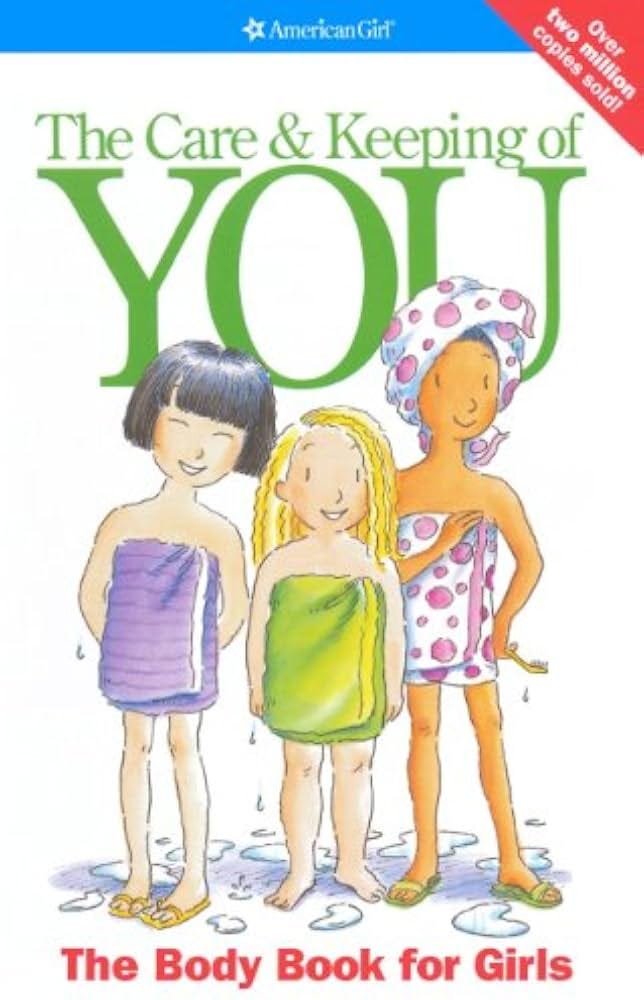
We were having sex at fifteen but didn’t learn about consent until we went to college three years later, shining a haunting blacklight on the four years we just served in American high schools. We were taught to avoid getting raped but also to drink jungle juice out of Gatorade coolers in our friends’ basements; we studied Roe v. Wade in our women’s studies classes and then had to Google things like can I still buy Plan B in my state? after it was reversed. We were raised on diet culture and then told to be body positive and then, oh wait, the new thing is to be body neutral. I hope you’re keeping up! You wouldn’t want anyone to know that you might still harbor internalized and outdated perspectives on womanhood during hot girl summer, after all.
Oh, and ‘girl’ was out (it’s infantilizing!) but now it’s in (we’re reclaiming it!).
Right, girls?!
Anyone tired yet?
After the Me Too movement, started by Tarana Burke, gained traction, there was perhaps a premature sigh of relief. At least from me. Third Wave Feminism was going to fix the last dregs of inequality. Third and final wave, I thought naively. Big-time athletes and Hollywood stars were being held accountable. Surely the moral arc of the universe was bending toward justice, as it always does at the end of an American film. Women (me) carried around Chanel Miller’s Know My Name in their handbags! Universities were forced to take stronger stances on sexual assault! Social media exploded with qualified professionals (and random lay people) posting infographics about love-bombing, emotional abuse, narcissism, and the rest! Documentaries exposed some of the darkest patriarchal threats to women! The Bechdel Test became a thing people name-dropped in conversation! Hooray!
As a woman who simultaneously felt like it could never happen to me, but also, experienced it personally and at length, this was a momentous moment. It was going to get better for the girlies.
The American landscape has changed in some substantial ways. Marriage statistics changed. Women’s standards (somewhat) changed. In the last few years, I saw a Tweet that read simply:
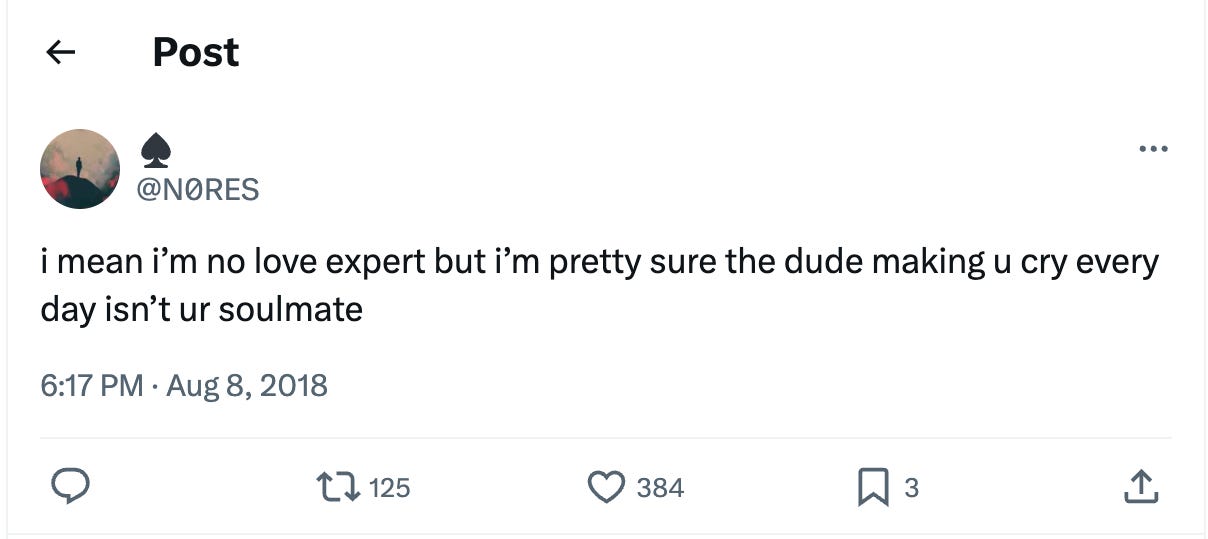
They Tweeted this like it was obvious! A given! In lowercase, no less! Like we collectively were not tolerating dudes making us cry! Anymore, at least.
Spoiler alert: I did in fact think the dude making me cry every day was my soulmate.
So women are learning, and tolerating less mistreatment, and the landscape is changing, and also, no men have been held accountable for the Epstein files. I used to think that feminism had a linear trajectory: women’s rights would keep shattering the glass ceiling shard by shard, and the patriarchy would get a little more dismantled for each up and coming generation. I thought that my girlhood experiences and abuses would read like foreign territory to girls born in the 2010s, the 2020s. The older I get, the more I see how entrenched the patriarchy is, how often we have to fight the same battles our foremothers fought, how change isn’t linear but rather a spiral, how liberation is not something earned once but something continuously stewarded, protected, and maintained lest we let our guards down.
What I’m saying is, I thought our story would mostly resonate with Millennials, girls who’d been girls when I was a girl. Now, more than ever, I think it’s for everybody.
Here’s to more people seeing what I simply couldn’t see for so long.
One of the hardest parts of unpacking sexual assault and emotional abuse is that at some point you think by now you’ve heard it all. After Weinstein and Nassar and Epstein, you think you know how big the quilt of abuse is. You think you can look at it all at once, armed with definitions and vocabulary: this is what happened to me. Deep breath. You can almost, almost compartmentalize it and move on with your life. But as I write, I keep finding patterns and fabrics in my quilt that I’d forgotten. On a phone call, my aunt reminds me of things about my abuser that I’d repressed. Another patch sewn. I find suicidal poetry in my old diary that I forgot I’d written. Stitch, stitch. I have a nightmare about my abuser a decade after he exited my life (this was like four nights ago, upon resurrecting this experience for Substack). I unfold square after square of my own story, remembering. It’s sad, revisiting these hollow places. The more people Shannon and I tell about this project, the more stories and patches get added to the quilt. You tell someone that you are writing about your abuse, and they will tell you theirs. The transgressions we have all endured are tingling on our skin, exploding, fizzing, asking to be let out.
I say, “I was in love with and controlled by a serial-cheating rapist.” I think this is the last word. It should be bad enough to fill the air. And yet someone will always pipe up, “You did!? Me, too.” Of course, that’s how the Me Too movement was born, and I am not here to reinvent the wheel. But it’s one thing when it’s Twitter blowing up and women from all over the world are contributing to an online march of black and white letters. It is another thing to have it spill down your coffee cups, run down your legs, dribble into ordinary conversations amongst ordinary people. To have it happen to your summer intern and to your best friend and even to your mom and probably to your grandmothers, who you didn’t get the chance to ask. The quilt is huge. Some days, it seems insurmountable—large enough to block out the sun. A dear friend once looked at me deadpan and casually said, as if it were old news, “I’m not sure every woman gets raped. But certainly every woman finds herself in bed having sex with someone and wishing she wasn’t.” Even the big statistics—like one in five college women have been raped—cannot cover the reality. There is more and more and more. It is less like a quilt and more like a clown pulling never-ending fabric out of his sleeve.
Does any woman get through this life unscathed?
Seeing the quilt in its entirety, I zoom out, examining my life as the details swing into place like pearls on a necklace. Like when I was in 6th grade and an old man visiting my elementary school told me that boys would soon be ‘all over me.’ Or the time I had to literally run out of a bar and hide to escape my old high school buddy who had made me his mission that night. The times I’ve been cat-called; the times my butt has been grabbed; the times I got angry and men told me to relax, it’s just a joke. The time, the time, the time. A lifetime of micro- and macro-aggressions, even in this so-called feminist era, for a relatively lucky woman, no less. Sure, #notallmen, but all women are dragging this heavy ass quilt behind us. It is full of sticks and mud and hair and blood, and for years of my life, it was smothering.
I just want to tuck you all under the quilt, on this side of it, where it’s safe and warm and okay. I just want you to know I am rubbing circles into your back; I am listening; I believe you. I don’t care if what happened is ‘technically’ against the law, or is ‘technically’ abuse, or is ‘technically’ assault. I care about the hollow feeling in your stomach that says that was wrong. I care about the nightmares and self-doubt planted. Men, afraid of losing their power to touch and grope in the name of ‘just messing around,’ will doubt your sense of wrongness, will ask for your blood-alcohol levels and how many community service hours you’ve been doing and what you were wearing. Some women, who gain power by being close to these men, or who fear validating your abuse will make them realize that they, too, are victims, may also doubt you. They will say prove that he didn’t have the right to touch you.
Despite all these purported feminist gains, people up to their ears in podcasts about healthy relationships are still not being treated well. People who would also be surprised to learn that it’s not normal to have their partner make them cry every day. I’ve seen colleagues become a puddle of tears from a two-word text message from their boyfriend. I’ve seen a woman post in detail to her Instagram stories about her escape from her abuser, only to update her stories a month later about them getting back together. There are still warehouses full of untested rape kits. Despite all this education and democratic knowledge-sharing and reimagining of norms, femininity, gender, and more, so many of us are still settling for less than we deserve. And we are still hurting.
But my handhold on this particular quilt of heartache started to loosen when I connected with Shannon. The sad patches we had embroidered alone in our respective self-loathing quiets ended up being puzzle pieces; our stories fit together. The boy who hurt her in Wisconsin was the boy who hurt me all the way in Arizona. I mean that literally; Shannon and I were abused by the same man, at basically the same time, two thousand miles apart, in our formative high school and early college years.
It was so easy to doubt our own stories. Maybe we were overthinking it. Maybe it wasn’t that bad. He was just having a hard time with his mental health. He was just struggling with his parents. He was a good guy. He wouldn’t do this. But Shannon and I got to be mirrors for each other, and what we saw in the reflection solidified what our guts had known all along.
Although he was the bridge that connected us, Shannon and I have now navigated so much more womanhood together than just excavating our wounds.
As we swapped stories, unveiling more and more disturbing details, putting the pieces together, Shannon never came to me and said, “Let’s write this down and DESTROY HIM.” She said, “Are you okay? Did he hurt you?” This writing isn’t meant to be a bloodbath. It is only one of a thousand attempts at healing.
We have altered our perpetrator’s name, not because he is innocent, or because we are scared of him, or because we do not wish to ruin his life. Let me be perfectly clear: there is a vengeful part of me that would quite like to ruin his life, actually. There is a part of me that thinks it’s rather unfair that his LinkedIn is going to say “Ph.D.” instead of “rapist.”
He may be etched into our past, but he is not invited into our still-promising futures, and to name him would also be to carry him forward, when he is better left behind. Finally, after years of giving a shit, I don’t care what he does next.
This is memoir. It’s not a legal case against him. No one can object. I don’t want my truth on trial. No one can strike any detail, no matter how small, from the record. Shannon’s and my stories corroborate each other’s.
Henry, which is the name we’ll be using, stole chapters of our lives that were supposed to be some of the happiest and most care-free. He walked away with our innocence. At times, Shannon and I both considered dangerous coping mechanisms that threatened our futures. I thought I would never find love again. Nearly a decade after his intrusion into our lives, we have finally been able to sit at the computer and breathe forward what happened to us. This isn’t a witch hunt. It’s a warning.
This is for every teenage girl who is taught that jealousy is cute. This is for women who think it’s normal that their boyfriends tell them how to dress. This is for girls who cry every night even though there was no physical violence. This is for the girls who made themselves small and erased themselves for men who tactically taught them that they weren’t good enough. And it’s for the women who, now gaining the language to describe what happened to them, are horrified, and just want to squeeze their inner children for all that they couldn’t protect themselves from.
Y’all are magic.